


When you’re ready to build a permanent life in the United States with your spouse, understanding your path to a green card is essential. Adjustment of status after marriage offers a way to obtain lawful permanent residence without leaving the country, keeping you and your family together throughout the process.
- Adjustment of status is the application process you use when you’re already physically present in the United States and want to become a lawful permanent resident.
- This contrasts with consular processing, where you apply for an immigrant visa at a U.S. consulate or embassy abroad.
The key difference is location: adjustment of status happens entirely within U.S. borders, while consular processing requires you to complete an interview and obtain your visa outside the country.
Your path forward depends on who you’re married to.
- If your sponsoring spouse is a U.S. citizen, you have immediate visa availability and can often file your petition and adjustment application simultaneously. The process typically moves faster, and you may qualify even if you’ve overstayed your visa, as long as you entered the United States legally.
- If your sponsoring spouse holds a green card, you’ll face longer wait times due to visa category limitations, and maintaining valid immigration status throughout the process becomes critical.
In this guide, we’ll explain the ins and outs of how individuals can legally pursue their green card, so that you can move forward with confidence.
Consular Processing vs. Adjustment of Status: Which is Right for You?
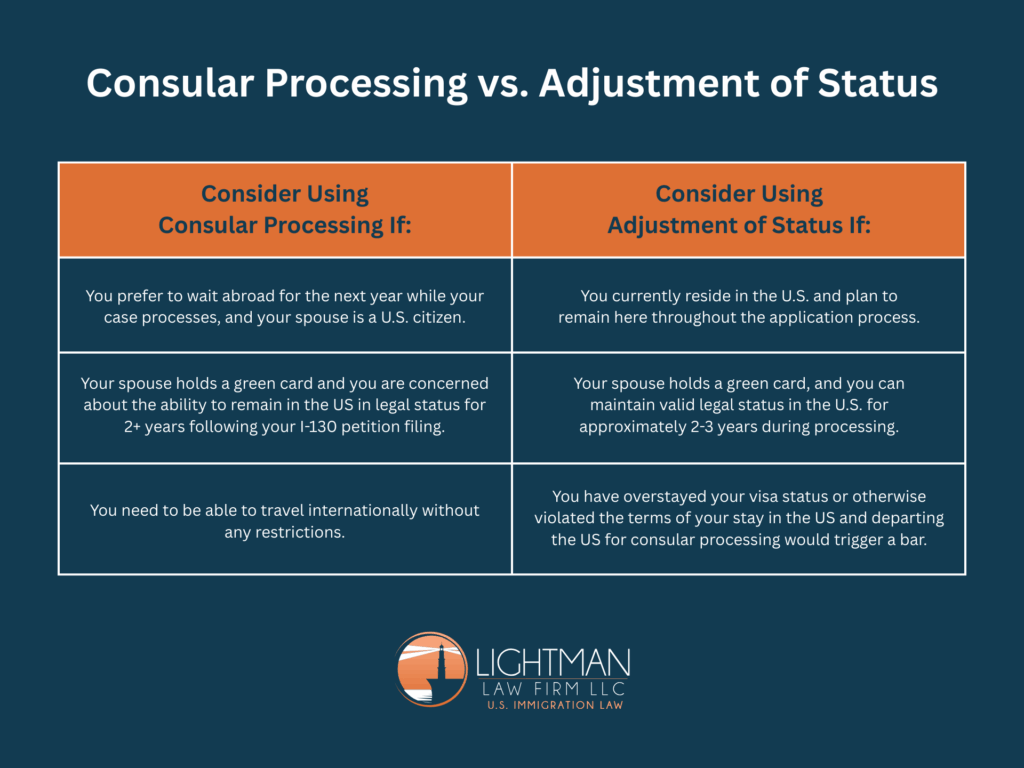
Choosing between consular processing and adjustment of status depends on your current location and immigration circumstances. Both paths lead to the same destination (a green card), but the journey looks different.
The choice between these two pathways hinges on where you’ll live during processing and your sponsor’s citizenship status:
- If you’re already settled in the U.S. and can maintain lawful status (especially important when sponsored by a green card holder), adjustment of status keeps you stateside throughout the multi-year journey. This is the generally more stable option, and it means you can apply for work authorization and advance parole during this time.
- Consular processing makes sense when you’d rather wait overseas or when maintaining continuous legal status in the U.S. proves challenging for the 2+ years typical in green card holder sponsorship cases. In some cases, this ends up being faster than AOS, but it will require you to attend an interview at a U.S. embassy or consulate in your home country.
5 Adjustment of Status Requirements: Do You Qualify?

Before filing your adjustment of status application, you need to meet specific eligibility criteria. Understanding these requirements helps you determine whether you qualify.
- Physical presence in the U.S. requirement
You must be physically present in the United States when you file Form I-485 and when USCIS makes its final decision. This ensures adjustment of status serves its intended purpose of allowing people already in the country to transition to lawful permanent resident status without international travel.
- Lawful entry requirement
You must have most recently entered the United States lawfully. You may still qualify even if you overstayed your visa or worked without authorization, as long as your initial entry was legal. However, if you entered unlawfully, meaning without inspection, adjustment of status typically isn’t available unless you qualify for a specific waiver.
- Bona fide marriage requirement
USCIS scrutinizes every marriage-based green card application to verify the relationship is genuine. You’ll need to demonstrate your marital relationship through joint financial accounts, shared housing, photos together, and evidence that you share your lives as a married couple. Immigration officers are trained to spot marriage fraud.
- Inadmissibility grounds
Immigration law lists numerous grounds that can disqualify you from receiving a green card, including certain criminal convictions, immigration violations like prior deportations or misrepresentation, health-related issues, and likelihood of becoming a public charge. Some grounds have waivers available, but others create permanent bars.
- Maintenance of status (for marriage to green card holders)
If your sponsoring spouse is a lawful permanent resident rather than a U.S. citizen, you must be in lawful immigration status when you submit your adjustment application. The differences between U.S. citizen sponsors and green card holder sponsors also extend beyond status maintenance:
- U.S. citizens can petition for their spouses as immediate relatives with no waiting period. Green card holders must petition through the family preference system (F2A category), which creates waiting periods that currently extend beyond two years.
- U.S. citizen spouses can sponsor even if the foreign national overstayed, while green card holder sponsorship requires stricter immigration compliance.
The 7-Step Process to Formally Adjusting Your Status
The adjustment of status journey follows a structured timeline with clear milestones.
- File Form I-130 (Petition for Alien Relative)
Your U.S. citizen or green card holder spouse initiates the process by filing Form I-130 with USCIS. This petition establishes the family relationship and proves your spouse’s eligibility to sponsor you. If your spouse is a U.S. citizen, you can file Form I-130 and Form I-485 simultaneously (concurrent filing). - File Form I-485 (Application to Register Permanent Residence or Adjust Status)
Form I-485 is your actual green card application. This comprehensive form asks about your entire immigration history, criminal record, employment, and whether any grounds of inadmissibility apply.- Complete honesty is required, as misrepresentation can result in permanent inadmissibility.
- Submit supporting forms (I-765, I-131, I-693)
Along with your I-485, you can file Form I-765 for employment authorization, Form I-131 for advance parole to travel internationally, and Form I-693 for your required medical examination.- The employment authorization document allows you to legally work while waiting for your green card decision.
- Biometrics appointment
USCIS will schedule you for a biometrics appointment within 4-8 weeks of filing. They’ll capture your fingerprints, photograph, and signature for background checks screening criminal history and security concerns.- Missing this appointment can delay your case significantly.
- Approval of work and travel authorization
If you filed Forms I-765 and I-131, USCIS will adjudicate these separately. Employment authorization documents and advance parole typically arrive within 3-12 months. Once you receive your employment authorization document, you will also be sent your Social Security number. - Adjustment of status interview
USCIS will schedule you and your sponsoring spouse for an in-person interview at a local field office, typically 8-18 months after filing. The immigration officer will review your application, ask questions about your relationship and background, and assess whether your marriage is genuine. Both spouses must attend together. - Receive decision
The officer may approve your case at the interview, request additional evidence, or state that your case needs supervisory review. If approved, your physical green card arrives within 2-4 weeks.- If you’ve been married less than two years at approval, you’ll receive a conditional green card valid for two years.
If married more than two years, you’ll receive a ten-year green card.
- If you’ve been married less than two years at approval, you’ll receive a conditional green card valid for two years.
What are the 7 Critical Documents You Need for Your Adjustment of Status Application?
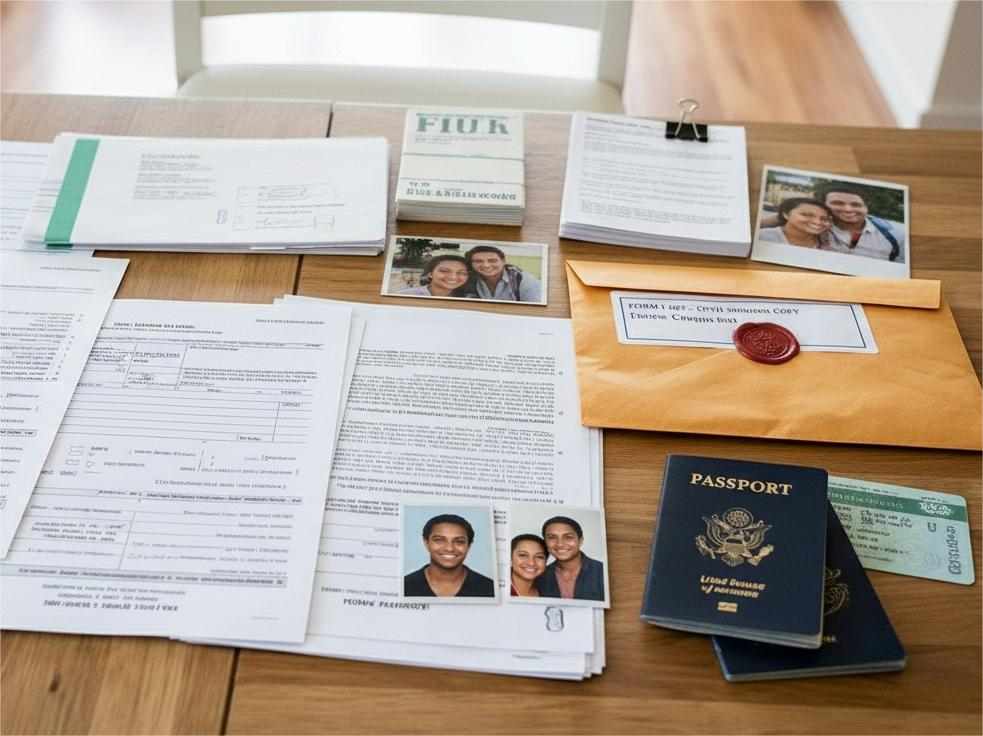
Document preparation makes or breaks adjustment of status cases. Missing documents create delays, and incomplete evidence raises suspicion.
- Form I-130 documents
Your petitioning spouse needs proof of citizenship (U.S. passport, birth certificate, naturalization certificate) or lawful permanent residence (green card). Include your certified marriage certificate and evidence that any prior marriages legally ended through divorce decrees, annulment orders, or death certificates. You need bona fides evidencing the relationship along. The beneficiary also needs to provide passport, birth cert, divorce cert, etc.
- Form I-485 documents
Provide copies of all passport pages showing entry stamps and visa, your birth certificate with certified English translation if needed, Form I-94 arrival/departure records proving lawful entry, and two passport-style photos taken within 30 days of filing.all immigration related docs, like visa stamps, I-94, approval notices, etc.
- Medical examination (Form I-693)
Schedule your medical exam with a USCIS-approved civil surgeon. The exam includes a physical examination, vaccination review, and communicable disease testing. The civil surgeon completes Form I-693 in a sealed envelope that you submit with your application.
- Affidavit of Support (Form I-864)
Your sponsoring spouse must demonstrate they can financially support you at 125% of federal poverty guidelines for your household size. This requires tax returns for the past three years, recent pay stubs, and employment verification. If your spouse doesn’t meet the income threshold, you may use household assets or secure a joint sponsor.
- Evidence of bona fide marriage
Include joint bank statements, joint credit card bills, joint leases or mortgage documents, joint utility bills, insurance listing both spouses, life insurance naming your spouse as beneficiary, and evidence of joint purchases. Provide photos throughout your relationship, affidavits from friends and family, and evidence of children if applicable.
- Civil documents (birth certificates, marriage certificate, etc.)
All foreign-language documents must have certified English translations. The translator must certify they are competent in both languages and that the translation is complete and accurate.
- Photos and identification
Provide two identical color passport-style photographs for each applicant taken within 30 days of filing. Include copies of government-issued identification for both spouses.
Discover Proven Legal Services to Support Your Adjustment of Status Journey
Compiling your adjustment of status application on your own can be a daunting task
Every document must meet USCIS specifications, translations must be properly certified, and your evidence needs to tell a compelling story about your genuine marital relationship. Missing or improperly prepared documents are among the top reasons for delays and requests for additional evidence.
At Lightman Law, we know exactly what USCIS expects to see. We’ll review your documentation thoroughly, identify any gaps before filing, and ensure everything is formatted correctly and submitted on time. Our team has guided hundreds of couples through the document preparation process, and we’re ready to take this burden off your shoulders so you can focus on your future together.
Contact us today to discuss your case and learn how we can streamline your adjustment of status application from start to finish.
7 Common Adjustment of Status Mistakes (& How to Avoid Them)
Even small errors can derail your green card application. Understanding common pitfalls helps you avoid costly delays.
- Traveling without advance parole
Once you file Form I-485, leaving the United States without advance parole in hand automatically abandons your adjustment application (with limited exceptions for H-1B and L-1 visa holders). Apply for advance parole with your initial filing, wait to receive the document, and consult your immigration attorney before any international travel.
- Failing to maintain lawful status (for LPR sponsors)
If your spouse is a green card holder, you must maintain lawful status from filing through final approval. This can span years. Overstaying your visa or working without authorization during this period makes you ineligible for adjustment.
- Insufficient evidence of bona fide marriage
Generic or minimal evidence raises red flags. USCIS officers recognize patterns suggesting fraud. Real couples leave extensive paper trails of shared lives. If your evidence is legitimately limited, address this proactively in a detailed cover letter.
- Potential misrepresentation or fraud
Lying on immigration forms, hiding prior violations, failing to disclose criminal history, or entering a marriage solely for immigration benefits constitutes fraud. Fraud can result in permanent bars to admission, criminal prosecution, and deportation. Complete honesty is non-negotiable.
- Incomplete or incorrect forms
USCIS will reject incomplete applications, causing delays of months. Follow instructions precisely, answer every question, and use exact legal names matching your official documents. Double-check dates, addresses, and biographical information.
- Not disclosing criminal history
USCIS conducts thorough background checks. Arrests, charges, and convictions will surface. Failing to disclose criminal history constitutes misrepresentation, which creates a separate ground of inadmissibility. Even dismissed charges or expunged records typically need disclosure.
- Filing too soon after entry to the US.
Submitting your adjustment of status application immediately after entering the United States can raise suspicions of visa fraud or misrepresentation of intent. Allowing at least 90 days between entry and filing helps demonstrate you didn’t misrepresent your intentions when seeking admission.
An experienced immigration attorney brings clarity to a complex process. They’ve handled hundreds of cases and know what USCIS looks for, which mistakes create problems, and how to present your case most effectively.
The investment in qualified legal representation often saves far more in avoided delays and denials than the attorney fees cost.
5 FAQs on Preparing for the Adjustment of Status Interview

The adjustment of status interview is the most nerve-wracking part of the process for many couples. Understanding what to expect helps you walk in prepared.
- When and where do the interviews occur?
USCIS typically schedules interviews 8-18 months after filing, though timelines vary by field office. You’ll receive an interview notice by mail approximately 2-4 weeks before your scheduled date specifying the time, location (your local USCIS field office), and required documents. Arrive at least 15 minutes early. - Who attends the interview?
Both you and your sponsoring spouse must attend together. The immigration officer will interview you as a couple, asking questions about your relationship.- In sole cases, the officer may separate you to ask questions individually. Your immigration attorney may attend with you if you choose.
- What types of questions are asked at the interview?
Officers ask about how you met, when you started dating, details about your wedding, where you live together, your daily routines, your families, financial arrangements, and future plans. Questions can range from basic to detailed.- The officer is assessing whether you know each other as married couples naturally would.
- How do I prove my marriage is genuine?
Bring updated evidence to your interview beyond what you included in your application. Joint bank statements, credit card bills, photos from recent months, correspondence to both spouses at your marital residence, joint tax returns, health insurance, beneficiary designations, and affidavits from people who know you as a couple all strengthen your case. - What happens after the interview?
In the best scenario, the officer approves your case at the interview’s end. More commonly, the officer indicates your case needs supervisory review or awaits final background clearances, and you’ll receive a decision by mail within 30-120 days- If the officer identifies issues, you may receive a Request for Evidence or Notice of Intent to Deny.
Understanding the Costs: Adjustment of Status Fees Breakdown
Adjustment of status requires multiple filing fees that add up quickly. Understanding the complete cost breakdown helps you budget appropriately for your marriage-based green card application.
| Form/Service | Cost | What It Covers |
| Form I-130 (Petition for Alien Relative) | $625 (online) $675 (paper) |
Establishes the family relationship between U.S. citizen/LPR and spouse |
| Form I-485 (Adjustment of Status Application) | $1,440 (age 14+) $950 (under 14, filing with parent) |
Main green card application; includes biometrics fee |
| Form I-765 (Employment Authorization/Work Permit) | $260 (when filed with I-485) $520 paper or $470 online (standalone) |
Allows you to work legally while your green card is pending |
| Form I-131 (Advance Parole/Travel Document) | $630 | Permits international travel while your application is pending |
| Form I-693 (Medical Examination) | $200-$500 (varies by doctor) | Required immigration medical exam by USCIS-approved civil surgeon |
| Form I-864 (Affidavit of Support) | $0 (no USCIS fee) | Proves financial support; sponsor completes this form |
| Total Cost (most common scenario) | $2,955-$3,255+ | I-130 + I-485 + I-765 + I-131 + medical exam |
Additional costs to consider:
- Attorney fees: $4,000+ (varies by complexity and location)
- Document translation: $15-$40 per page
- Passport photos: $10-$20
- Certified copies of documents: $10-$50 per document
- Travel to interview: Varies by location
Planning your budget comprehensively prevents financial surprises. While adjustment of status costs several thousand dollars before attorney fees, the investment secures your legal permanent residence and your ability to build a stable life in the United States with your spouse.
What Happens Next After Your Green Card is Approved?

Green card approval opens new chapters in your life, but it also comes with ongoing responsibilities and future opportunities.
- Receiving your green card
USCIS will mail you an approval notice shortly after your case is approved. Your physical green card typically arrives 2-4 weeks later. The card includes your photo, name, birth date, and expiration date.
Verify all information is correct immediately. Your green card is proof of your lawful permanent resident status and authorization to work for any employer.
- Conditional residence (if married less than 2 years)
If your marriage was less than two years old when USCIS approved your green card, you receive conditional permanent residence valid for two years. Conditional residence carries the same rights and responsibilities as full permanent residence but expires after two years. This conditional period exists to prevent fraud.
- Removing conditions on residence (Form I-751)
You must file Form I-751 jointly with your spouse during the 90-day period before your conditional green card expires. This petition requires updated evidence proving your marriage remains genuine.
Filing late can result in losing your lawful permanent resident status. After filing I-751, your status automatically extends while USCIS processes your petition.
- Permanent residence (if married 2+ years)
If your marriage was more than two years old when your green card was approved, you receive a ten-year green card representing full lawful permanent resident status. This card simply needs renewal before expiration by filing Form I-90 approximately six months before the expiration date.
- Traveling with your green card
As a lawful permanent resident, you can travel internationally and return to the United States freely. Always carry your green card when traveling abroad.
Extended absences (generally trips longer than six months) can raise questions about whether you’ve abandoned your permanent residence.
- Path to citizenship/naturalization timeline
Most green card holders can apply for U.S. citizenship through naturalization after five years of permanent residence. Spouses of U.S. citizens qualify after just three years if they’ve remained married to and living with the same U.S. citizen spouse.
Naturalization requirements include physical presence, good moral character, English language ability, knowledge of U.S. history and civics, and taking an oath of allegiance.
Ready to Begin Your Adjustment of Status Journey? Schedule Your Consultation Today
Pursuing a green card through adjustment of status after marriage represents hope, commitment, and the promise of building your future together in the United States. The process demands attention to detail, thorough preparation, and patience as you navigate USCIS requirements.
At Lightman Law, we understand the stakes.
Your immigration case isn’t just paperwork: it’s your family, your career, your dreams.
We bring clear-headed, creative advocacy to every adjustment of status case we handle. Our experienced, multilingual team blends legal expertise with modern technology and genuine personal attention, ensuring your green card application is complete, compliant, and compelling.
We guide you through every form, gather and organize your evidence, prepare you thoroughly for your interview, and advocate fiercely when complications arise. We’ve helped hundreds of couples navigate adjustment of status, and we’re ready to help you.
Contact Lightman Law today to schedule your consultation. Let’s turn your immigration goals into reality together, without surprise, delay, or compromise.
