

Getting a green card through marriage is one of the most common pathways to lawful permanent residence in the United States. The process involves:
- Multiple forms
- Documentation requirements
- An interview to verify your bona fide marriage
Many couples have received their green card through marriage . This guide covers requirements, timeline, costs, and interview preparation, from understanding which visa category applies to you, to preparing for your green card interview and planning for U.S. citizenship.
What Is a Marriage Based Green Card?
A marriage based green card allows the foreign spouse of a U.S. citizen or lawful permanent resident to live and work anywhere in the United States. The marriage green card category represents one of the fastest routes to permanent residence, with some applicants receiving approval in as little as 9 to 15 months.
The type of green card you receive depends on how long you’ve been married when the green card is approved.
Marriage Green Card Categories
- 10-Year Green Card
A permanent green card issued to spouses of U.S. citizens or green card holders married for more than two years at approval. Valid for 10 years. This is also known as an IR-1 visa.
- 2-Year Conditional Green Card
A conditional green card issued to spouses of U.S. citizens or green card holders married for less than two years at approval. Valid for two years and requires filing Form I-751 to remove conditions. This is also known as a CR-1 visa.
U.S. Citizen vs. LPR Sponsor Differences
- U.S. citizen sponsors can file Form I-130 and Form I-485 concurrently if the foreign spouse is already in the United States, potentially shortening the timeline to under a year.
- Green card holder sponsors face quota restrictions that extend wait times considerably.
Two Pathways to a Marriage Based Green Card
- Adjustment of status (Form I-485) is used when the foreign spouse is currently in the United States.
- Consular processing (Form DS-260) applies when the foreign spouse lives abroad and will obtain their immigrant visa at a U.S. embassy or consulate.
7 Requirements You Must Meet for a Marriage Based Green Card Eligibility
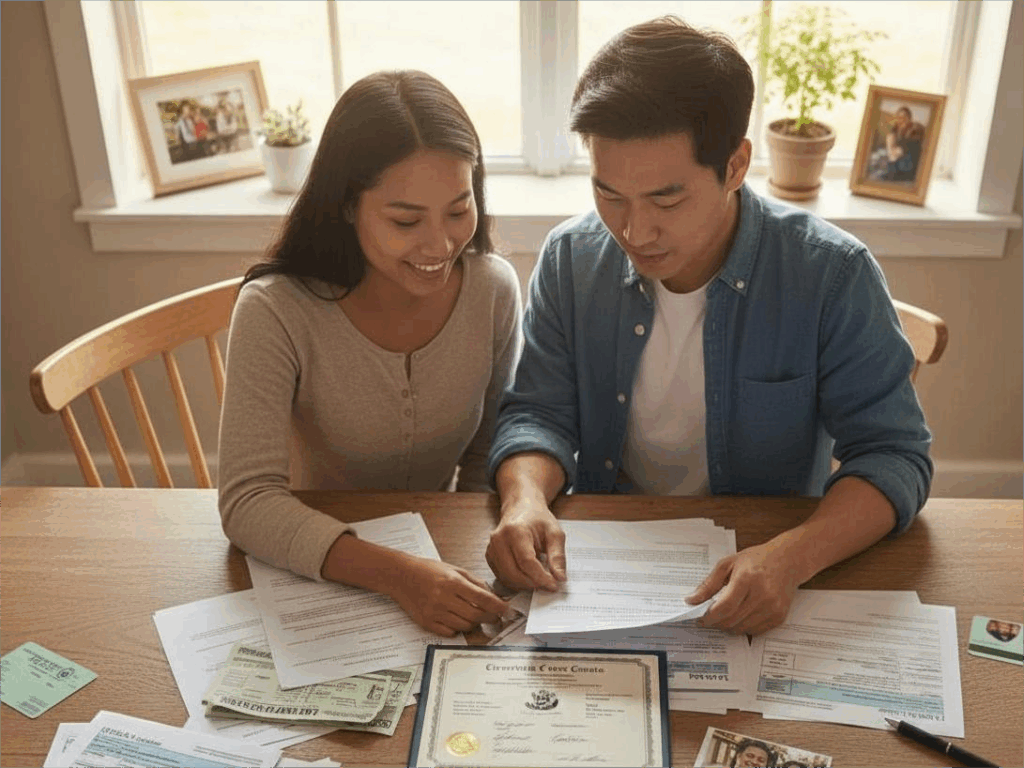
USCIS enforces strict eligibility requirements to prevent marriage fraud and ensure sponsors can financially support their immigrant spouse. Before you invest time and money into the green card application, verify that you meet these fundamental requirements.
- Legal Marriage Requirements
Your marriage must be legally valid with a government-issued marriage certificate. USCIS updated its policy recently to clarify that only marriages legally recognized and registered with civil authorities qualify. Both spouses must have been legally free to marry, with all previous marriages properly terminated through divorce, annulment, or death.
- Bona Fide Marriage Standard
The most scrutinized aspect is whether your marriage is bona fide, meaning you married for love and companionship, not solely to obtain immigration benefits. Even if your marriage is genuine, you must prove it with concrete evidence.
-
- What USCIS Looks For
U.S. Citizenship and Immigration Services (USCIS) examines whether you and your spouse share a life together through financial entanglement, cohabitation, and emotional connection. The burden of proof is entirely on you.
- What USCIS Looks For
-
- Categories of Evidence
Joint financial accounts show financial interdependence. Housing documentation proves you live together. Photos spanning the length of your relationship document your time together.Affidavits from friends and family provide third-party verification. Travel records, communication records, and receipts from joint purchases all strengthen your case.
- Categories of Evidence
-
- Red Flags that Trigger Scrutiny
Significant age differences (20+ years), limited shared language, very short courtship followed by immediate marriage, living at separate addresses, minimal joint financial documentation, and previous marriages to U.S. citizens all trigger enhanced scrutiny.If any apply to you, consider working with an experienced immigration attorney.
- Red Flags that Trigger Scrutiny
- Sponsor Requirements (Citizen or LPR Status)
The petitioning spouse must be either a U.S. citizen or lawful permanent resident. Your sponsor must be at least 18 years old and willing to sign the Affidavit of Support.
The Affidavit of Support is a legally binding contract where your U.S. citizen or LPR sponsor agrees to financially support you (see #6).
The affidavit remains in effect until the immigrant spouse becomes a U.S. citizen, permanently leaves the United States, passes away, or earns 40 working quarters (approximately 10 years of work).
- Age Requirements (Where Applicable)
The U.S. citizen or LPR sponsor must be at least 18 years old to file Form I-130.
- Admissibility Standards
The foreign spouse must be admissible to the United States without disqualifying factors including:
-
- Certain criminal history
- Immigration violations
- Health-related grounds
- National security concerns
Some inadmissibility issues can be overcome with a waiver (Form I-601 or I-601A). An immigration medical examination is required.
- Financial Ability to Support
The U.S. sponsor must demonstrate they can financially support the immigrant spouse at 125% of the federal poverty guidelines. This requirement prevents the foreign spouse from becoming a public charge, defined as receiving certain federal, state, or local means-tested public benefits.
A sponsor with a household size of two needs a minimum income of approximately $25,550. Supporting documents include:
-
- Recent tax returns
- W-2 forms
- Recent pay stubs
- Employer letters
If the sponsor cannot meet this requirement, they can include the immigrant spouse’s income if living together, use a joint sponsor who meets requirements independently, or demonstrate qualifying assets.
- No Disqualifying Factors
Disqualifying factors include being in removal proceedings, having been found guilty of marriage fraud previously, being subject to the three-year or ten-year bar for unlawful presence, or having committed immigration fraud.
Marriage Green Card Documents Checklist: 5 Key Things You Need to Apply
USCIS requires extensive paperwork to process your application. Gathering these documents early prevents delays.
Form I-130 (Petition for Alien Relative) establishes the qualifying relationship. Required documents include proof of sponsor’s U.S. citizenship or permanent resident status, marriage certificate, divorce decrees or death certificates from previous marriages, passport-style photos, and evidence of legal name changes.
Form I-485 (adjustment of status in U.S.) or DS-260 (consular processing abroad) requires passport copies, birth certificate with English translation, Form I-94 arrival record (for AOS), visa copies, passport photos, and Form I-693 medical examination in a sealed envelope.
- Bona Fide Marriage Evidence
Joint bank statements, joint credit cards, lease or mortgage documents in both names, utility bills, insurance policies, wedding and relationship photos, communication records, affidavits from friends and family, travel records, and receipts from joint purchases.
- Medical Examination
Form I-693 must be performed by a USCIS-approved civil surgeon. The exam costs $200-$500 and checks for communicable diseases and required vaccinations (COVID-19 no longer required as of January 2025).
- Common Documentation Mistakes
Submitting photocopies when originals are required, failing to translate foreign documents, missing signatures or dates, using outdated form versions, and insufficient bona fide marriage evidence all cause delays.
Setting Expectations for Processing Time: How Long Does It Really Take?

Processing time varies based on:
- Sponsor type
- Application pathway
- USCIS workload
- Whether your application triggers additional security checks
For spouses of U.S. citizens filing for adjustment of status, total processing typically ranges from 9 to 15 months. You can obtain employment authorization within 3 to 6 months by filing Form I-765. Travel authorization (advance parole) through Form I-131 takes a similar timeframe.
For spouses of U.S. citizens using consular processing, the timeline is generally 12 to 24 months from start to finish, including Form I-130 approval (8-12 months), National Visa Center processing (3-6 months), and consular interview scheduling.
For spouses of lawful permanent resident sponsors (F2A category), processing time is significantly longer due to visa availability limitations. Current wait times range from 2 to 4+ years depending on priority dates and country of origin.
Processing times fluctuate based on USCIS workload and policy changes. Delays can result from incomplete applications that trigger Requests for Evidence (RFE), background checks requiring additional review, or high volume at your local field office.
Marriage Green Card Cost: 3 Tables Show the Complete Breakdown (What You’ll Actually Pay)
The total cost of obtaining a marriage green card ranges from approximately $6,085 to over $9,285 depending on your pathway and circumstances.
Table 1: Government Filing Fees by Pathway
| Form/Service | Adjustment of Status (Spouse in U.S.) | Consular Processing (Spouse Abroad) |
| Form I-130 (Petition for Alien Relative) | $625 (online) / $675 (paper) | $625 (online) / $675 (paper) |
| Form I-485 (Adjustment of Status) | $1,440 | N/A |
| Form DS-260 (Immigrant Visa Application) | N/A | $325 |
| Affidavit of Support | N/A | $120 |
| Form I-765 (Work Permit) | $260 (filed with I-485) | N/A |
| Form I-131 (Travel Document) | $630 | N/A |
| USCIS Immigrant Fee | N/A | $220 |
| Subtotal (Government Fees) | $2,955 – $3,005 | $1,290 – 1,340 |
Table 2: Additional Costs to Budget For
| Expense Category | Estimated Cost | Notes |
| Medical Examination (Form I-693) | $200 – $500 | Required for both pathways; cost varies by doctor/location |
| Document Translation | $15 – $40 per page | For non-English documents |
| Official Copies | $10 – $50 per document | Birth certificates, marriage certificate, divorce decrees |
| Passport Photos | $20 – $40 | USCIS-compliant photos |
| Travel to Interview | Varies | Depends on distance to USCIS office or embassy |
| Courier/Mailing Fees | $50 – $150 | For document submission and delivery |
| Immigration Attorney Fees | $4,500+ | Optional but recommended |
| Total Estimated Cost | $4,795 – $5,280+ | Varies by pathway and case complexity |
Table 3: Cost Comparison by Sponsor Type
| Scenario | Timeline | Total Cost Range | Key Considerations |
| Married to U.S. Citizen (in U.S.) | 9-15 months | $7,750 – $9,285+ | Can file I-130 and I-485 concurrently; faster processing |
| Married to U.S. Citizen (abroad) | 12-24 months | $6,085 – $7,620+ | Consular processing required; lower government fees |
| Married to a Green Card Holder (in U.S.) | 2-4+ years | $7,750 – $9,285+ | Must wait for visa availability (F2A category); longer timeline may require status maintenance |
| Married to Green Card Holder (abroad) | 2-4+ years | $6,085 – $7,620+ | Longer wait times; costs spread over extended period |
Looking for Assistance? Get a Case Evaluation from an Experienced Immigration Attorney

Marriage-based immigration involves complex regulations and high stakes for your family’s future. Working with an experienced immigration attorney significantly improves your chances of approval.
Lightman Law has successfully guided hundreds of thousands of couples through the marriage green card process over four decades of combined practice. Contact Lightman Law today for a consultation and discover how our clear-headed, creative advocacy can help you navigate the marriage green card process with confidence.
Adjustment of Status vs Consular Processing: Which Marriage Green Card Pathway Is Right for You?
Choosing between adjustment of status and consular processing depends on where the foreign spouse currently lives, how they entered the United States, and what trade-offs make sense for your family.
| Factor | Adjustment of Status (AOS) | Consular Processing |
| Who It’s For | Foreign spouse currently in the U.S. | Foreign spouse living abroad |
| Total Processing Time | 9-15 months (U.S. citizen spouse) 2-4+ years (LPR spouse) |
12-24 months (U.S. citizen spouse) 2-4+ years (LPR spouse) |
| Government Fees | $2,955 – $3,005 | $1,170 – $1,220 |
| Can I File Everything Together? | Yes (if married to U.S. citizen) – I-130 and I-485 filed concurrently | No – I-130 must be approved first, then DS-260 |
| Work Authorization While Pending | Yes – Apply with Form I-765; typically approved in 3-6 months | No |
| Travel Authorization While Pending | Requires Advance Parole (Form I-131); do not leave U.S. without it or application is abandoned | Not applicable |
| Interview Location | Local USCIS office in the U.S. – both spouses attend together | U.S. Embassy / Consulate in spouse’s country |
| When You Receive Green Card | Mailed to U.S. address after approval | Mailed to U.S. address after entry to the U.S. on immigrant visa |
| Best For | • Spouse in the U.S. • Staying together during process • Need to work immediately |
• Spouse not in the U.S. • Prefer lower fees • Ok with temporary separation |
Adjustment of status allows couples to stay together, and the foreign spouse can obtain employment authorization quickly. However, without advance parole, leaving the United States abandons your application.
Consular processing is required when the foreign spouse lives abroad. It costs less but means temporary separation, and the foreign spouse cannot work in the United States until the process is complete.
Certain entry types make you inadmissible for adjustment of status, including entering without inspection or entering as a C1/D crewman. You generally cannot adjust status unless you qualify for certain exceptions. An experienced immigration attorney can review your entry history and determine which pathway is available.
Conditional vs Permanent Green Card: 5 Critical Differences You Need to Know
If you’ve been married for less than two years when your green card is approved, USCIS will issue a conditional green card valid for two years rather than a permanent green card valid for ten years. Understanding these critical differences helps you prepare for what comes next.
- Validity Period: Two-Year Conditional vs. Ten-Year Permanent
A conditional green card is valid for exactly two years. After those two years, your status terminates unless you successfully remove the conditions. A permanent green card is valid for ten years and renewal is straightforward. - When You Receive Each Type: Marriages Under 2 Years vs. 2+ years at Approval
If your marriage is less than two years old when approved, you receive conditional residence. If married for two years or longer by approval, you receive permanent residence immediately.
- Removing Conditions Requirement: Form I-751 Filing Requirements and Timeline
Conditional residents must file Form I-751 jointly with their spouse during the 90-day window immediately before the conditional green card expires. File too early, and USCIS rejects your petition. File even one day late, and your status terminates.- Form I-751 requires updated evidence of your bona fide marriage including joint financial documents, cohabitation evidence, photos, tax returns, and affidavits. The filing fee is $715, and processing takes 12 to 24 months.
- What Happens If You Divorce: Different Implications During Conditional Period
Divorce during conditional residence means you must file for a waiver demonstrating your marriage was entered in good faith. If you divorce after receiving your permanent green card, it has no direct impact on your immigration status. - Renewal Process: Conditional Green Card Removal vs. Standard 10-year Renewal
Form I-751 requires extensive documentation and potential interview. Form I-90 to renew a permanent green card is a straightforward administrative process with no marriage proof required.
Marriage Green Card Interview: What to Expect & How to Prepare
The green card interview is the final step in the marriage-based immigration process. A USCIS officer or consular officer meets with you and your spouse to verify that your marriage is bona fide.
- What to Bring
Arrive at least 15 minutes early with organized documents. Be sure to bring:
-
- The interview notice (Form I-797)
- Government-issued photo ID for both spouses
- Travel documents
- Sealed medical examination (Form I-693) if not previously submitted
- Proof of petitioner’s citizenship or permanent resident status
- Original marriage certificate
Also bring additional bona fide marriage evidence, such as: joint bank statements, utility bills, photos, tax returns, lease documents, insurance policies, and affidavits.
- What to Wear
Dress in business casual or business professional attire.
- Types of Questions Asked
Immigration officers ask questions to verify your application and assess your marriage. Questions cover relationship history (how you met, engagement, wedding details), current living situation (address, home layout, daily routines), financial matters (joint accounts, expenses, income), and family information (in-laws, holidays, personal habits).
- How Officers Assess Authenticity
Officers observe body language, interaction between spouses, and consistency between answers. Red flags include:
-
- Contradictory answers about basic facts
- Excessive nervousness
- Lack of knowledge about your spouse
- Minimal shared financial documentation
- Living at separate addresses
- Possible Separate Questioning
If the officer suspects fraud, they may conduct a Stokes interview, questioning each spouse separately and comparing answers. Stokes interviews involve detailed questions about daily activities, home layout, financial arrangements, and personal habits.
- After the Interview: Possible Outcomes
Immediate approval means your green card will be mailed within 2-4 weeks. Decision pending means additional review time. Request for Evidence (RFE) means the officer needs more documentation. Denial can be appealed or you may reapply with stronger evidence.
After Your Marriage Green Card Is Approved: 4 Important Next Steps
Receiving your green card approval is cause for celebration, but understand your rights, responsibilities, and next steps.
- Receive Your Green Card
For adjustment of status, your green card arrives within 2-4 weeks. For consular processing, you receive an immigrant visa stamp valid for 180 days. Your green card is mailed 4-8 weeks after U.S. entry. Pay the USCIS Immigrant Fee ($220) before traveling. - Understand Your Conditional Residence
If you received a conditional green card, file Form I-751 during the 90-day window before expiration. Missing this deadline terminates your status. - Know Your Rights & Responsibilities
You can live and work anywhere in the United States, travel internationally (with restrictions), and sponsor certain family members. You cannot vote. You must obey all laws, file U.S. taxes, carry your green card, and notify USCIS of address changes. - Plan for Citizenship
If married to a U.S. citizen, you can apply for citizenship after three years of permanent residence (versus five years for others).
Over 40+ Years, These are the 9 Most Common Marriage Green Card Questions We Get
With over four decades of combined immigration practice, certain questions come up repeatedly. Here are the most frequent questions with clear answers.
- How long do you have to be married to apply for a green card?
You can apply immediately after getting legally married. There’s no minimum waiting period. However, if your marriage is less than two years old when approved, you’ll receive a conditional green card valid for two years. - Can I apply for a green card if I entered the U.S. illegally?
If married to a U.S. citizen and you entered without inspection, you generally cannot adjust status inside the United States. You may be eligible for consular processing abroad after applying for a waiver of unlawful presence (Form I-601A). If married to a lawful permanent resident, options are much more limited. - What is conditional residence and how do I remove conditions?
Conditional residence is a two-year probationary period for spouses married less than two years at approval. To remove conditions, file Form I-751 jointly with your spouse during the 90-day window before the conditional green card expires. USCIS will review updated evidence of your bona fide marriage and may schedule another interview. - Can I work while my green card application is pending?
If adjusting status in the U.S., you can apply for employment authorization (Form I-765) with your application, and work permits typically arrive within 3-6 months.- Consular processing applicants cannot work until the immigrant visa is approved. Some applicants already on work visas can continue working while the green card processes.
- Can I travel outside the U.S. during the application process?
If adjusting status, leaving the country without advance parole will abandon your application. You must file Form I-131 for advance parole, which takes 3-6 months to approve.- Important exception: If you’re in H-1B or L-1 status with a valid visa stamp in your passport, you can travel internationally without advance parole while your green card application is pending. For consular processing applicants abroad, travel isn’t restricted, but be available for your scheduled interview.
- What if my spouse doesn’t meet the income requirements?
You can include the immigrant spouse’s income if living together, use a joint sponsor who meets requirements independently, or demonstrate qualifying assets. For U.S. citizen sponsors, assets must equal three times the income shortfall. If you cannot meet requirements through these options, you may need to delay your application. - How does previous visa overstay affect my eligibility?
If married to a U.S. citizen, you can generally adjust status despite overstay, but leaving the U.S. may trigger three-year or ten-year bars. If married to a lawful permanent resident, you cannot adjust status after overstay and must use consular processing, facing unlawful presence bars. An immigration attorney can review your specific situation to determine the best strategy. - When can I apply for U.S. citizenship after getting a marriage green card?
If married to a U.S. citizen, you can apply for citizenship after three years of permanent residence, compared to five years for most green card holders. You must remain married to and living with the same U.S. citizen spouse throughout those three years. If you divorce during this period, you’ll need to wait the full five years. - What happens if we’re denied?
A denial can be appealed within 30 days to the USCIS Administrative Appeals Office or you may reapply with stronger evidence. If denied based on insufficient evidence, filing a new application with better documentation may be your best option.
Contact an immigration attorney immediately after denial to evaluate your options and protect your rights.
Ready to Start Your Marriage Green Card Application? Contact Lightman Law Today

The marriage green card process involves complex regulations, strict deadlines, and high stakes for your family’s future. With over 40 years of experience handling family-based immigration, we have the expertise to guide you through every step.
Our multilingual team understands that every couple’s situation is unique. We offer comprehensive services including:
- Case evaluation
- Complete application preparation
- Evidence gathering assistance
- Interview preparation
- Representation in appeals or complex proceedings
Don’t navigate the marriage green card process alone. Contact Lightman Law today to schedule your case evaluation. Let us put our decades of experience to work for your family.